
 November 25, 2025
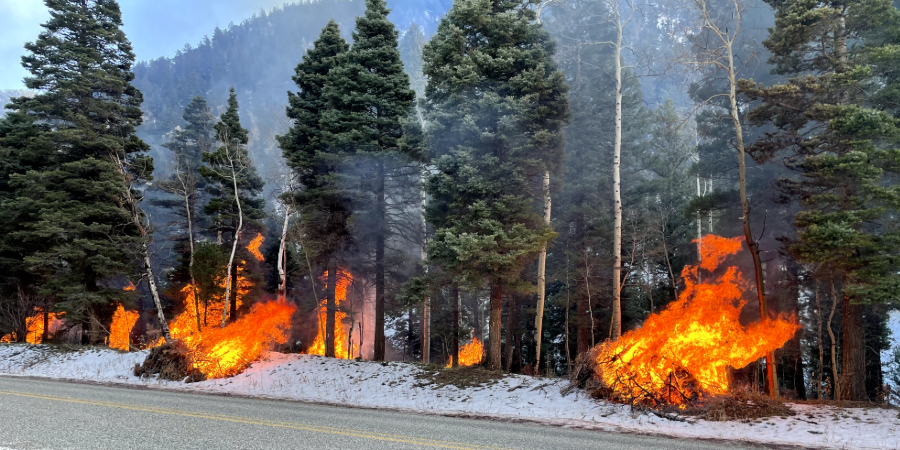
With the arrival of winter weather in Northern New Mexico, fire crews are preparing to begin pile burning operations across Carson National Forest this fall and winter. Work may first occur as early as Dec. 1 along or near Highway 150 and the Wheeler Peak Trail, as well as Hopewell Lake.
The exact days of ignitions for projects will depend on wind, weather, fuel moisture conditions and required approvals. The public is encouraged to sign up for email updates.
“This shift in weather is telling us it’s time to pivot to pile burning,” said Fuels and Fire Staff Officer Jamie Long. “With the ground dampened or snow-covered, we can’t burn grasses, forbs and leaf litter, but the moisture lines up for pile burning.
Piles are made from slash, such as branches and brush stacked by contractors during thinning work. Thinning and pile burning is often the first step to reduce fuels in dense forest stands. When followed by understory or jackpot burning, it has been shown to be the most effective combination to reduce the threat of wildfire.
A full list of all potential prescribed fires this fall and winter are available on the Carson National Forest website, where more information about the use of fire in forest restoration is also available. Previously announced understory and jackpot projects may still occur if site-specific conditions and weather allow.
Early Fall Accomplishments
Over the last month and a half, crews treated 12,340 acres with jackpot and understory burning, translating to significant long-term outcomes for forest health, community resilience and public enjoyment of the forest:
- Fire crews completed the Ojo Sarco Prescribed Fire earlier this month, treating 391 acres adjacent to the community of Ojo Sarco. The work to reduce the threat of wildfire to the neighborhood has benefited community members over the years, first with public greenwood cutting followed by dead and down fuelwood collection. Thinning, which was partially conducted by the Rocky Mountain Youth Corps, and pile burning also occurred.
- Crews also made significant progress on the Kiowa-San Cristobal Wildland Urban Interface project, treating 1,777 acres adjacent to four communities: Arroyo Hondo, Kiowa Village, San Cristobal and Turley Mill (some of the acreage treated were piles after an early fall rain). The public conducted dead and down fuelwood collection throughout the area after pre-burn thinning occurred.
- Across the Rio Grande Gorge, crews completed the 10,172-acre Lamy/Barela Prescribed Fire near Tres Piedras, N.M., opening up the understory and creating more wildlife corridors and encouraging growth of additional forage for grazing species (deer, elk) and cattle, reducing pressure on grasslands in the area.
Smoke
Unlike large wildfires, prescribed fires are short-term in duration and planned with advance notice. Staff coordinate with the New Mexico Environment Department to conduct ignitions on days when smoke impacts are minimized.
Nonetheless, smoke will be present and may settle in some local or farther out areas in the evenings and overnight. Taking care of your health is important as smoke can affect everyone. And preparing for prescribed fire helps you become smoke-ready for wildfires, when smoke abruptly shows up and can last longer. Smoke-ready tips are available online.
Photo by Earl Hidayetoglu/USDA Forest Service of piles burning along Highway 150 in Nov. 2024.


 NM Fire Info
Comments are closed.