
 June 5, 2026
Daily Update: June 5, 2026
Acres: 31,870 Start Date: May 14, 2026
Location: Capitan Mountain Wilderness Cause: Human caused
Personnel: 484 personnel Containment: 64% Contained
Fuels: Heavy dead fuels in the Peppin burn scar
Highlights: Wet weather conditions continue to subdue the fire as crews work towards containment.
Operations: On Thursday, crews continued to perform suppression repair work such as wood chipping and dozer line restoration. In other parts of the perimeter, they continued checking for containment and strengthening contingency lines. With Thursday’s weather, no aerial water or retardant drops were used. Aircraft used for this purpose vary widely in capacity, cost and benefits. The DC-10 VLAT (Very Large Aerial Tanker) can carry 9,400 gallons of water or retardant and drop it in a straight line almost a mile long, but must land between drops. The Canadair CL-145 Super Scooper carries a much smaller load of 1,400 gallons. A Super Scooper can refill in a matter of seconds without landing by scooping on a nearby lake. A group of them can repeat drops on a fire as quickly as every six minutes. The largest rotor craft (helicopters) can carry 2,600 gallons of water. Refilling a rotor craft can be done in natural bodies of water as well as drop tanks, often called “pumpkins,” which can be set up close to the fire and refilled by ground tankers. In addition to the ability to refill without landing, rotor craft can operate in tight quarters, such as canyons, and their ability to hover can make water drops more accurate. With multiple sizes and types of aerial tankers, and more in development, wildfire managers have many things to consider when ordering these resources. It is important to remember that aircraft alone will never extinguish a wildfire; without firefighters on the ground to take advantage of an airdrop, the airdrop will have only temporary results. A final word on aircraft support of wildfire is the importance of the TFR (Temporary Flight Restriction). The TFR is put in place to give firefighting aircraft the freedom to operate as needed for both routine and emergency contingencies. Whether firefighting aircraft are flying for emergency medical, retardant drop, information or other purposes, if an unknown drone or staffed aircraft is seen within the TFR, all fire aviation is grounded. “If you fly, we can’t.”
Weather: A flood watch has been declared by the National Weather Service for the area from noon to 6:00 p.m. today. These are subject to change so keep informed. The day will be hot with a chance of showers and thunderstorms. Wind will be very mild, becoming northwest in the afternoon. A drying and warming trend will continue into the weekend.
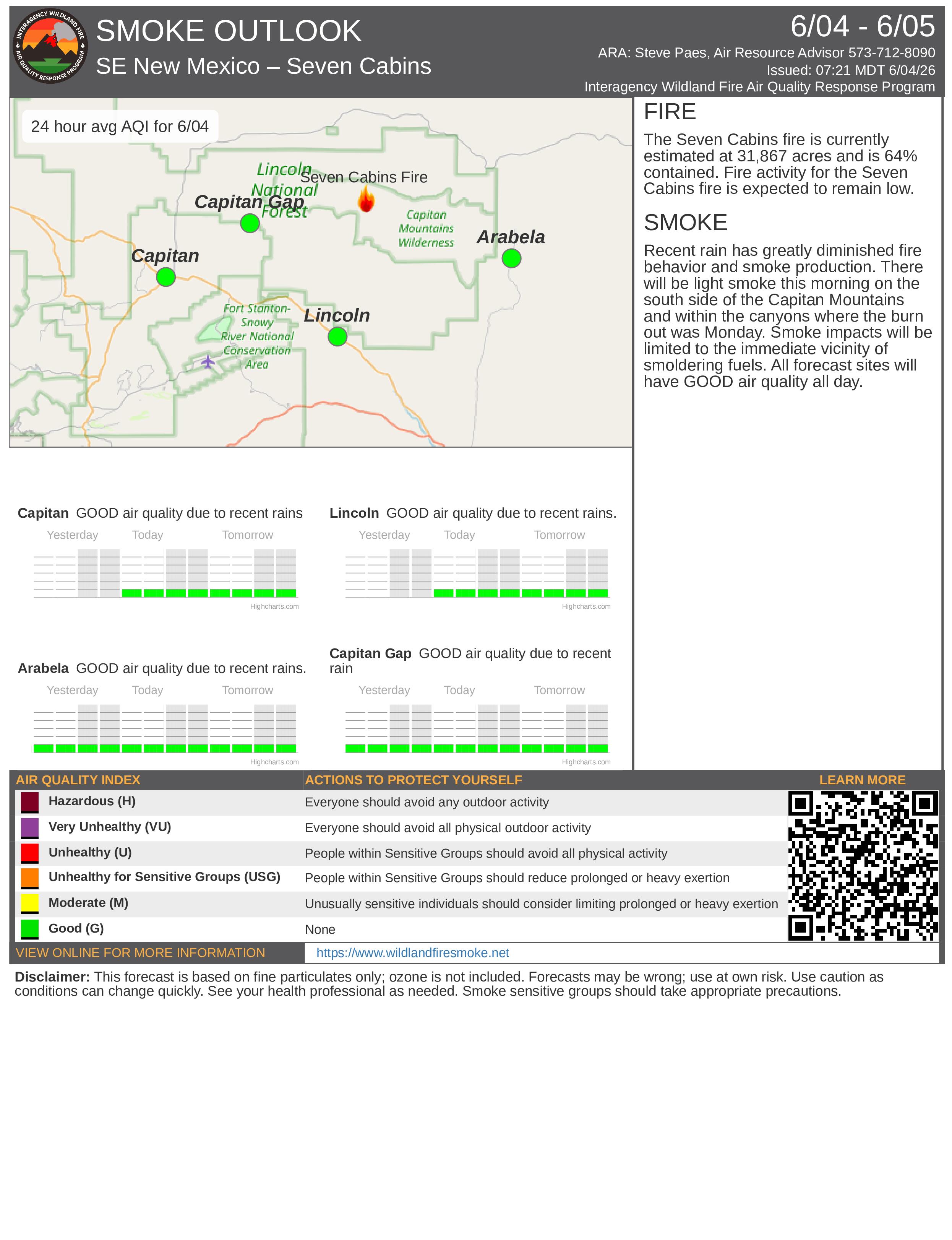
Smoke: Today, smoke should remain moderate and confined to the immediate area around the fire. As weather warms and dries, more smoke will be possible. For air quality information, please check local conditions at Fire.AirNow.gov.
Closures and Warnings: A forest closure is in effect across the Capitan Mountain area, extending east and south of Highway 246 to the Forest Service boundary and continuing south to Forest Service Road 57. Baca campground is included in the closure. Stage 1 fire restrictions also remain in effect. A Temporary Flight Restriction (TFR) is in place over the fire to ensure safe access for firefighting aircraft. If a drone enters the restricted airspace, all firefighting aircraft must be grounded to ensure safety. Remember “If You Fly, We Can’t.”
Forest Closure Order: (https://www.fs.usda.gov/r03/lincoln/alerts/order-03-08-01-26-001-seven-cabins-fire-closure)
Fire Restrictions: (https://www.fs.usda.gov/r03/lincoln/alerts/order-03-08-26-001-stage-1-fire-restrictions)
Evacuations: There are no evacuation orders associated with this fire at this time. For more information or to sign up for alerts, visit (https://www.lincolncountynm.gov/services/fire___emergency_services/index.php).
Safety: Crews, heavy equipment, and machinery remain active in and around the incident. The safety of firefighters and the public is our highest priority, and we ask everyone to stay aware of ongoing operations. Fire personnel will continue working along area road systems, and increased caution from the public helps keep both firefighters and community members safe.
Phone Number: 505-217-0120 (7a.m. – 7p.m.)
Email: 2026.SevenCabins@firenet.gov
Inciweb: https://inciweb.wildfire.gov/incident-information/nmlnf-seven-cabins-fire Facebook:https://www.facebook.com/SevenCabinsFire/



Comments are closed.